 Endura Coatings
Ceramic Composite Coatings
Series 100 Ceramic Composite Coatings
For Aluminum & Magnesium Substrates
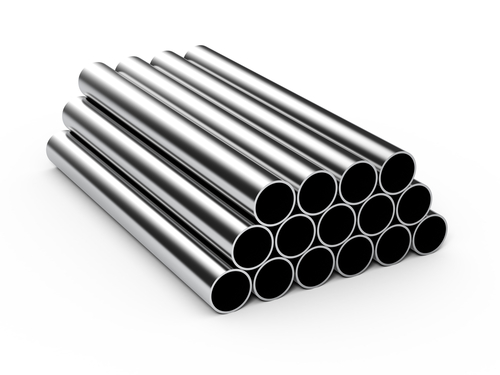
Endura's Series 100 is the industry-leading aluminium ceramic coating solution for aluminum and magnesium substrates, delivering surface hardness up to 65 Rc through a proprietary immersion-based spark deposition process. These Endura® Ceramic Hard Coatings transform the outermost layer of your workpiece into a protective ceramic oxide, which is further enhanced with vacuum-infused fluoropolymers to provide a highly uniform, protective barrier with superior non-stick, low-friction, and corrosion-resistant performance while replicating exact surface geometry.
View the performance factors for each Series 100 Ceramic Coating >>
Need something more?
Consider Endura®'s Infused Matrix™ coatings. These coating technologies are further reinforced with a variety of fluorochemistry enhancements which provide extra performance benefits including, but not limited to: superior corrosion resistance, low-friction and non-stick properties. Created by means of a proprietary vacuum impregnation process, our Infused Matrix™ coatings are truly unique, providing all of the benefits of traditional Teflon or “Teflon-like” coating within a wear-hardened ceramic matrix. These surface conversion technologies are used throughout several industries because they create improved release, lower friction, enhanced corrosion protection, and a harder, more wear-resistant surface than other anodic coatings available today.
Key Benefits of Endura® Series 100 Aluminium Ceramic Coating
Choosing Endura® Series 100 ceramic coating for aluminium and magnesium substrates delivers measurable performance advantages across critical manufacturing applications:
-
Superior Surface Hardness: Micro-surface hardness approaches 65 Rc (case-hardened steel equivalent) for outstanding abrasion and wear resistance.
-
Precise Dimensional Control: ~0.001 inch surface growth and ~0.001 inch matrix penetration maintains close tolerances on threads, holes, and complex geometry.
-
Corrosion and Chemical Resistance: The ceramic oxide layer acts as a barrier against corrosive chemicals, solvents, and aggressive wash-down environments.
-
Low Friction and Non-Stick Performance: Fluoropolymer infusion delivers dynamic friction as low as 0.08 (ASTM D1894) — ideal for mold release, food-contact, and sliding-surface applications.
-
Improved Dielectric Properties: Dense ceramic matrix provides electrical insulation advantages over untreated aluminum.
-
Permanent Integral Bond: The coating converts the substrate itself and will never chip, crack, flake, or peel.
-
Compatible with Complex Geometries: Encapsulates blind holes (up to 1.5x diameter depth) and through holes (up to 3x diameter depth).
Industries and Applications for Ceramic Coating on Aluminium
Endura® Series 100 aluminium ceramic coating is specified across a broad range of industries where surface durability, dimensional precision, and cleanliness are critical:
- Injection and Blow Molding: Improved mold release, extended tool life, and corrosion protection for high-cycle aluminum tooling.
- Food Processing and Packaging: FDA-compatible non-stick and corrosion-resistant surfaces.
- Aerospace and Defense: Hard, wear-resistant surfaces on lightweight aluminum components with minimal dimensional change.
- Medical Devices and Equipment: Non-stick, biocompatible surfaces on aluminum components for device manufacturing and assembly.
- Automotive and Transportation: Pistons, valves, housings, and other aluminum engine components requiring low-friction, wear-hardened surfaces.
- General Industrial Manufacturing: Fixtures, jigs, conveyor components, and precision-machined aluminum parts.
Series 100 - Ceramic Composite Coating Process
For Aluminum & Magnesium
Processing Illustration
Endura's Series 100 Infused Matrix™ process is a precise, four-stage ceramic coating sequence for aluminium and magnesium substrates. Each stage is critical to achieving the final composite ceramic surface — from initial surface preparation through ceramic oxide conversion to fluoropolymer infusion and final performance optimization:
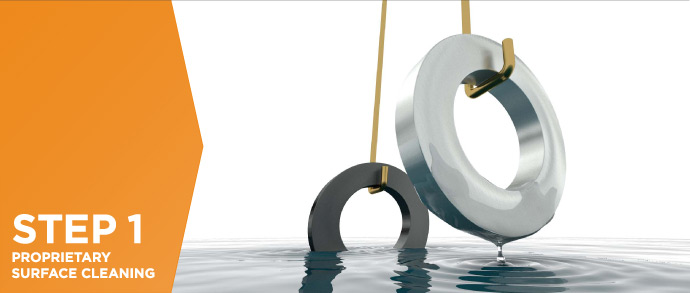
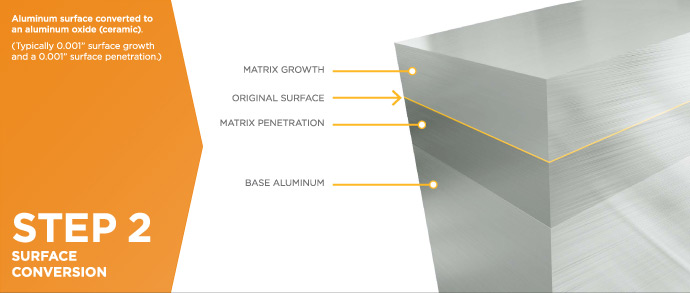
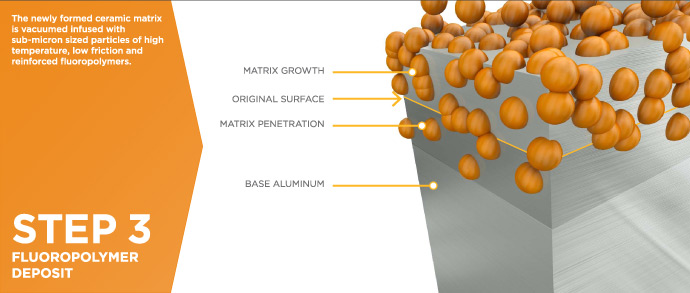
At Endura Coatings, we offer composite ceramic coatings which go through the following process:
Step 1: All aluminum and magnesium components are fully submerged in Endura's proprietary cleaning bath. This controlled immersion process removes surface oils, residual oxides, machining contaminants, and other surface impurities — ensuring a clean, reactive substrate for the ceramic conversion that follows.
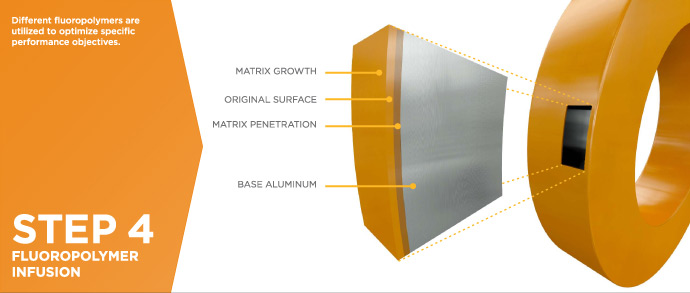
Step 2: Under a precisely controlled electric waveform, the parent aluminum substrate reacts with the acid-based electrolyte in a spark deposition process, converting the outermost metal layer into a dense aluminum oxide (ceramic). This creates approximately 0.001 inch of outward matrix growth above the original surface and approximately 0.001 inch of inward matrix penetration below it — producing a hard ceramic structure integral with the base aluminum.
Step 3: With the ceramic matrix fully formed — spanning both the matrix growth layer (above the original surface) and the matrix penetration zone (below it) — the part is transferred to a vacuum infusion chamber. Sub-micron sized particles of high-temperature, low-friction fluoropolymers are deposited throughout the open ceramic pores, saturating the composite structure across all matrix layers.
Step 4: In the final infusion stage, targeted fluoropolymer formulations are vacuum-impregnated throughout the complete ceramic matrix — from the outer matrix growth zone through the original surface layer and into the matrix penetration zone — completing the Infused Matrix™ composite ceramic surface. Endura® selects from proprietary fluoropolymer chemistries calibrated to your specific performance requirements: non-stick release, ultra-low friction, corrosion resistance, high-temperature stability, or custom combined profiles.
Frequently Asked Questions: Aluminium Ceramic Coating
Q: What is aluminium ceramic coating?
A: Aluminium ceramic coating is a surface conversion process — not a deposited film — that electrochemically transforms the outermost layer of your aluminum substrate into a dense, hard aluminum oxide (ceramic). At Endura®, this conversion is further enhanced with a proprietary vacuum infusion step to create the Series 100 Infused Matrix™ composite ceramic surface.
Q: What aluminum alloys are compatible with Series 100 ceramic coating?
A: Endura® Series 100 is compatible with most aluminum and magnesium alloys. Low-copper (less than 5%) and low-silicon (less than 7%) alloys are preferred for optimal coating performance.
Q: How hard is ceramic coated aluminium?
A: Endura® Series 100 ceramic coated aluminium achieves micro-surface hardness equivalent to up to 65–70 Rc, depending on alloy — approaching that of case-hardened steel — far exceeding standard hard anodize.
Q: Does ceramic coating change the dimensions of my aluminum parts?
A: Minimally. The Series 100 process produces approximately 0.001 inch of outward surface growth and 0.001 inch of inward matrix penetration (~0.002 inch total build). Endura® recommends finishing to a tighter-than-required tolerance before coating.
Q: What is the difference between ceramic composite coating and hard anodizing?
A: Unlike conventional hard anodize, Endura® Series 100 uses a high-energy spark deposition process to create a denser, harder ceramic oxide layer. The additional fluoropolymer infusion step adds non-stick, low-friction, and corrosion-resistance properties unavailable with standard hard anodizing.
Q: Is Endura® aluminium ceramic coating suitable for food contact applications?
A: Yes. Series 100 coatings can be formulated for food-contact compliance — providing non-stick, corrosion-resistant surfaces ideal for food processing and FDA/USDA-regulated manufacturing environments.
Q: What other coating solutions does Endura® offer?
A: Endura® also offers Electroless Nickel Plating (Series 200), Fluoropolymer Coatings, Solid/Dry Film Lubricant Coatings, Composite Diamond Coatings (CDC), and more.
Please complete our Coating Requirement Questionnaire
or call us
at 1.800.336.3872 to review & discuss your project requirements.
